


A humanoid robot can now be hired to clean a real apartment in the United States. The price sounds surprisingly familiar to anyone who has booked a cleaner in Toronto: US$30 an hour — roughly C$42 at current exchange rates.
That immediately raises a practical question for Toronto homeowners and cleaning companies: if a humanoid robot can vacuum, wipe surfaces, make a bed and clean a bathroom for about the same hourly price as a human cleaner, how long before robots replace house cleaners?
The short answer in 2026 is: not yet.
The more interesting answer is that robots may become genuinely competitive in routine maintenance cleaning before they become capable of replacing professional deep cleaning. The difference is not simply speed or intelligence. It is the combination of dexterity, touch, surface judgment, chemical choice, risk awareness and the ability to adapt continuously to a home that is never e twice.
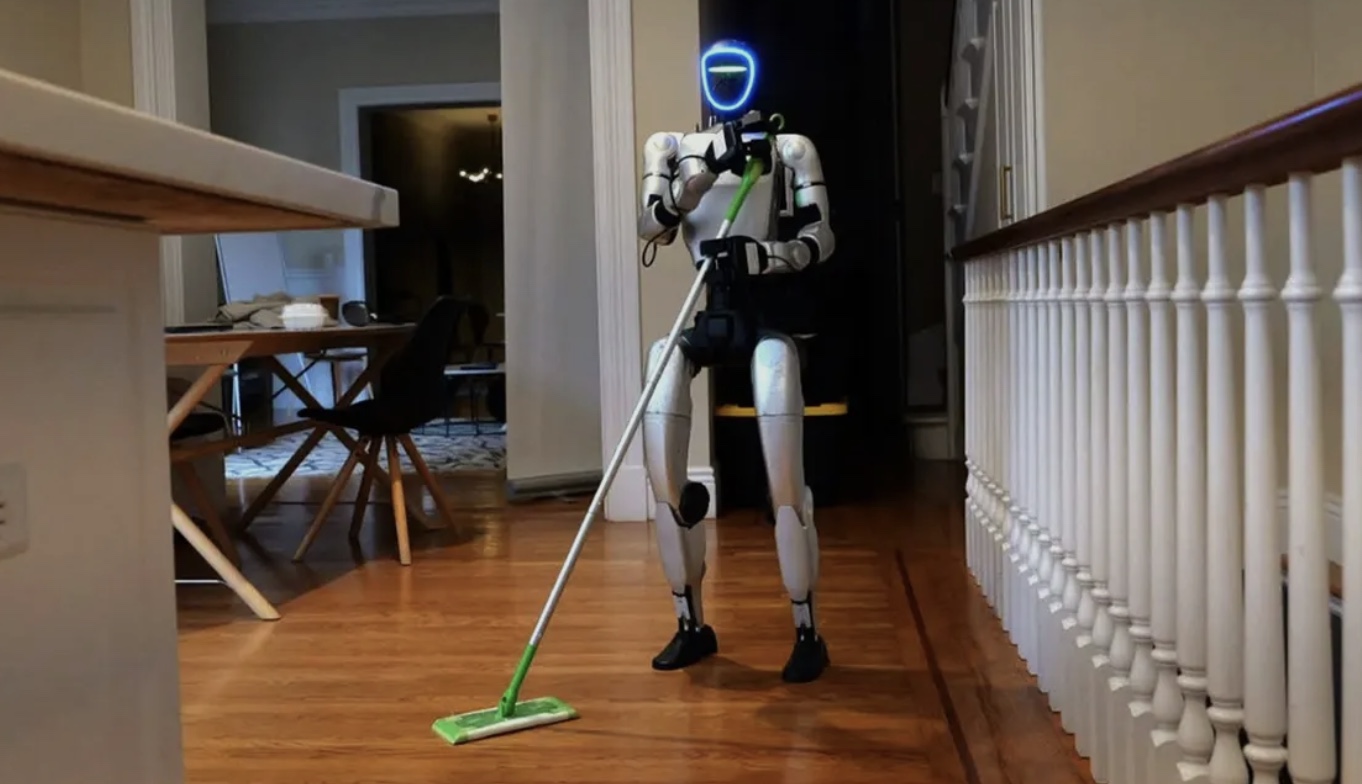
Illustrative service robot. This is not the Tau Robotics unit used in the San Francisco pilot.
A $30-an-Hour Robot Cleaner Is No Longer Science Fiction
In August 2026, a San Francisco resident hired a humanoid robot from Tau Robotics to clean her apartment for one hour. The robot vacuumed, made a bed and cleaned parts of the bathroom. The customer said the robot was slower than a human cleaner, but she was satisfied with the result and did not need to redo the work.
The video went viral and triggered the obvious debate: are cleaners about to be replaced?
There is one detail that changes the interpretation. The robot was teleoperated. A remote human operator was involved in controlling it. In other words, the robot was physically inside the apartment, but the cleaning was not yet a fully autonomous “send the robot in and let it figure everything out” service.
CBS reported that Tau’s pilot was offered to selected San Francisco households at US$30 per hour and that the robots cost about US$50,000 each to build. That makes the pilot important — but it does not prove that fully autonomous home cleaning is already commercially mature.
For Toronto, the story matters because it moves the conversation from “maybe one day” to “this is already being tested in real homes.”
Robot Cleaning Is Growing Fast — But Mostly on Floors
Robotics is already established in cleaning. It is just not yet the humanoid version many people imagine.
The International Federation of Robotics reported that more than 25,000 professional cleaning robots were sold in 2024 in its reporting sample, up 34% year over year. The main application was floor cleaning.
25,000+ professional cleaning robots sold in 2024
+34% year-over-year growth
Main use: floor cleaning
That distinction matters. Autonomous floor scrubbers, robot vacuums and other single-purpose systems work well because their environment and task are relatively constrained. A full home is different. A kitchen, bathroom, bedroom and living room require different tools, contact forces, movements and decisions.
Humanoid robotics is also attracting far more investment. Goldman Sachs Research increased its 2035 global humanoid-robot market forecast from US$6 billion to US$38 billion, cprogress and falling component costs.
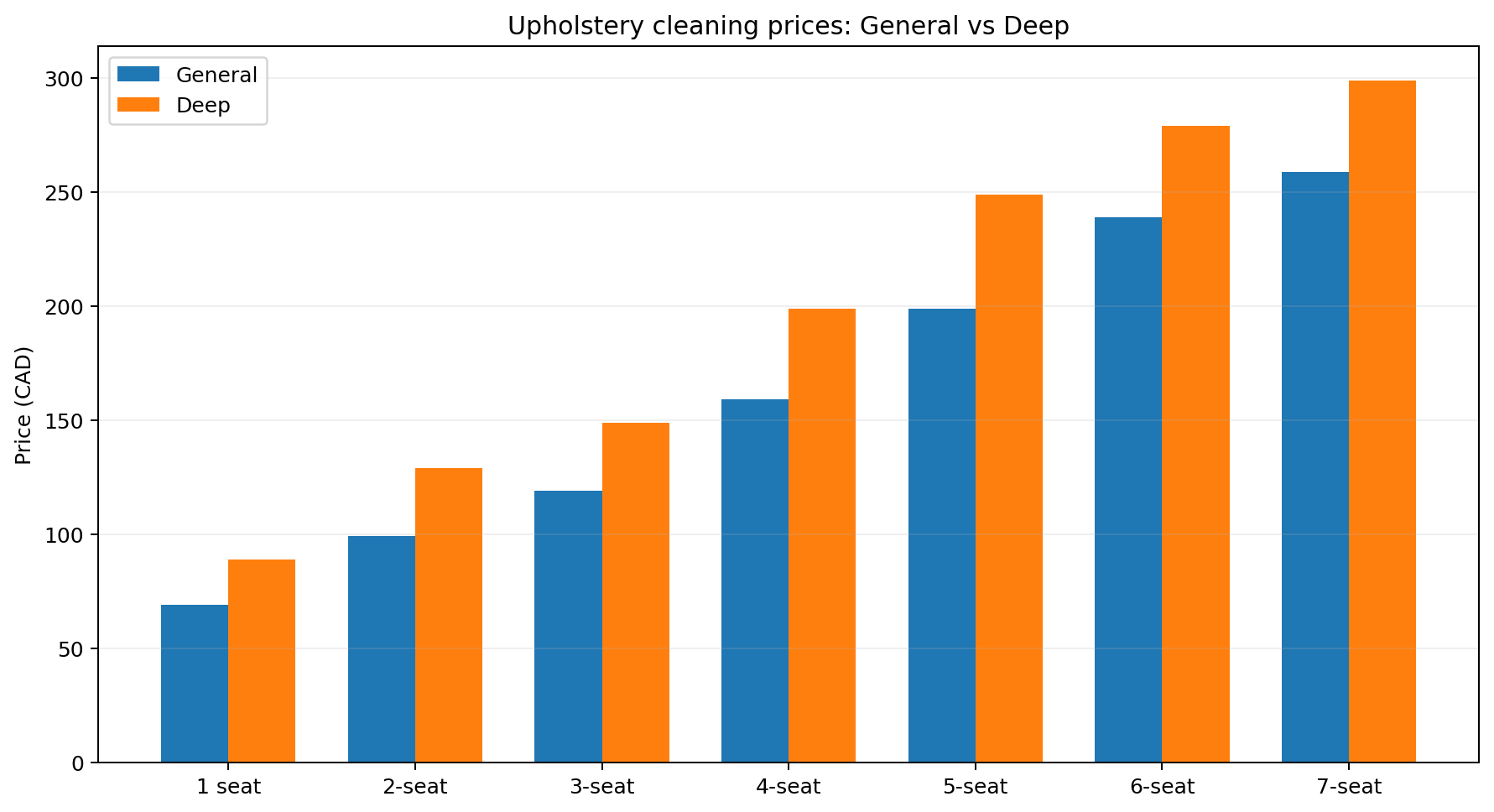
Chart: Goldman Sachs Research revised its 2035 humanoid-robot market estimate from US$6B to US$38B. This is a forecast, not current sales.
Robot Cleaner vs Human Cleaner: What Does C$40–42 per Hour Actually Buy?
The San Francisco pilot price creates an unusually clear comparison.
US$30 per hour converts to approximately C$42 per hour. Leronzo Cleaning Group currently lists hourly maintenance clper cleaner per hour, with a three-hour minimum.
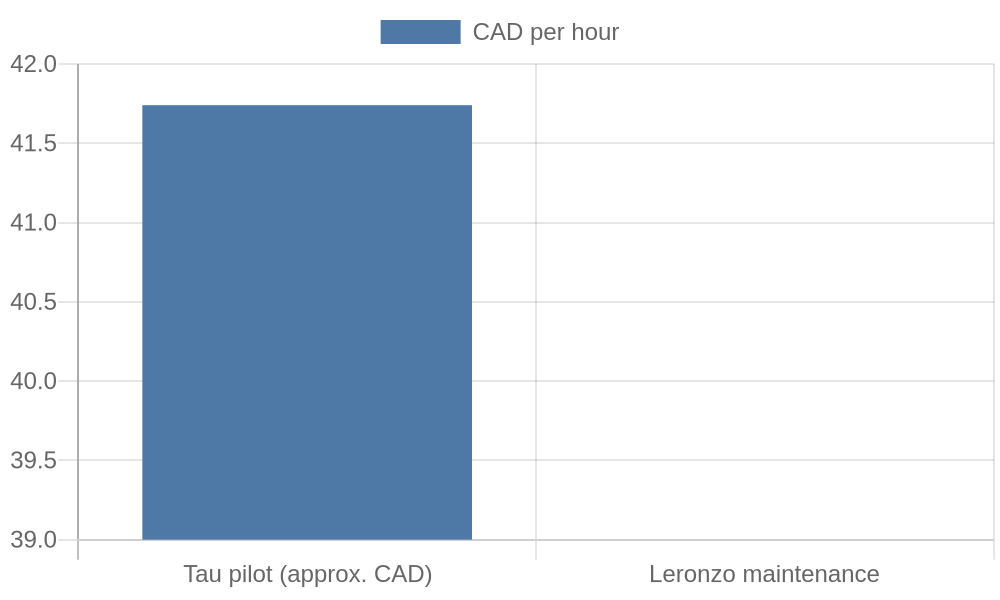
Important: these are not equivalent services. Tau’s US$30 rate is a U.S. pilot price for an emerging robot service. Leronzo’s C$39 rate is an active Toronto & GTA maintenance-cleaning rate. Exchange rates also move.
Still, the comparison raises the right question:
The real metric is not price per hour. It is useful cleaning completed per hour.
If two options cost almost the same per hour but one completes less work, needs remote assistance or cannot handle part of the cleaning scope, the hourly rate alone is misleading.
Routine Cleaning Is Where Robots Make the Most Sense
Routine cleaning is the part of residential cleaning that is easiest to standardize.
A regularly maintained home often needs repeatable tasks:
• vacuum open floor areas;
• mop accessible hard floors;
• wipe counters and other open surfaces;
• remove light dust;
• make beds;
• collect trash;
• perform basic bathroom maintenance;
• repeat the same route every week.
This is precisely where robotics has the strongest opportunity.
A humanoid does not necessarily need to “understand cleaning” at the same level as an experienced cleaner to become useful. If the environment is mapped, the surfaces are known and the work is repetitive, automation can gradually take over more of the physical routine.
That is why the most realistic near-term competition is not robot versus professional deep cleaner. It is robot versus a portion of recurring maintenance cleaning.
For homes that already stay in maintainable condition, regular cleaning is structured and predictable. Leronzo’s Weekly, Bi-Weekly & Every 4 Weeks Cleaning service is built around that same maintenance concept: keeping everyday dust, crumbs, fingerprints and light residue under control before they become heavy buildup.
Why Deep Cleaning Is a Different Problem
Deep cleaning looks similar from a distance: wipe, scrub, vacuum, rinse.
Up close, it is a different type of work.
Consider a stovetop. A routine clean may involve removing fresh cooking residue and wiping the surface. A deep clean may involve baked-on grease, carbonized residue around burners, narrow seams, edges and areas where the finish is already worn.
The cleaner is not simply applying more force.
The cleaner is constantly deciding:
• how much pressure is safe;
• whether the residue needs dwell time before agitation;
• which tool can be used without scratching;
• whether the surface is painted, coated, glass, stainless steel or another material;
• when a stronger product is justified;
• when a stronger product creates more risk than benefit;
• when to stop because the finish is beginning to react;
• whether a mark is dirt, damage or permanent discoloration.
Ts to refrigerators, cabinet fronts, faucets, shower glass, grout, painted trim and many other surfaces.
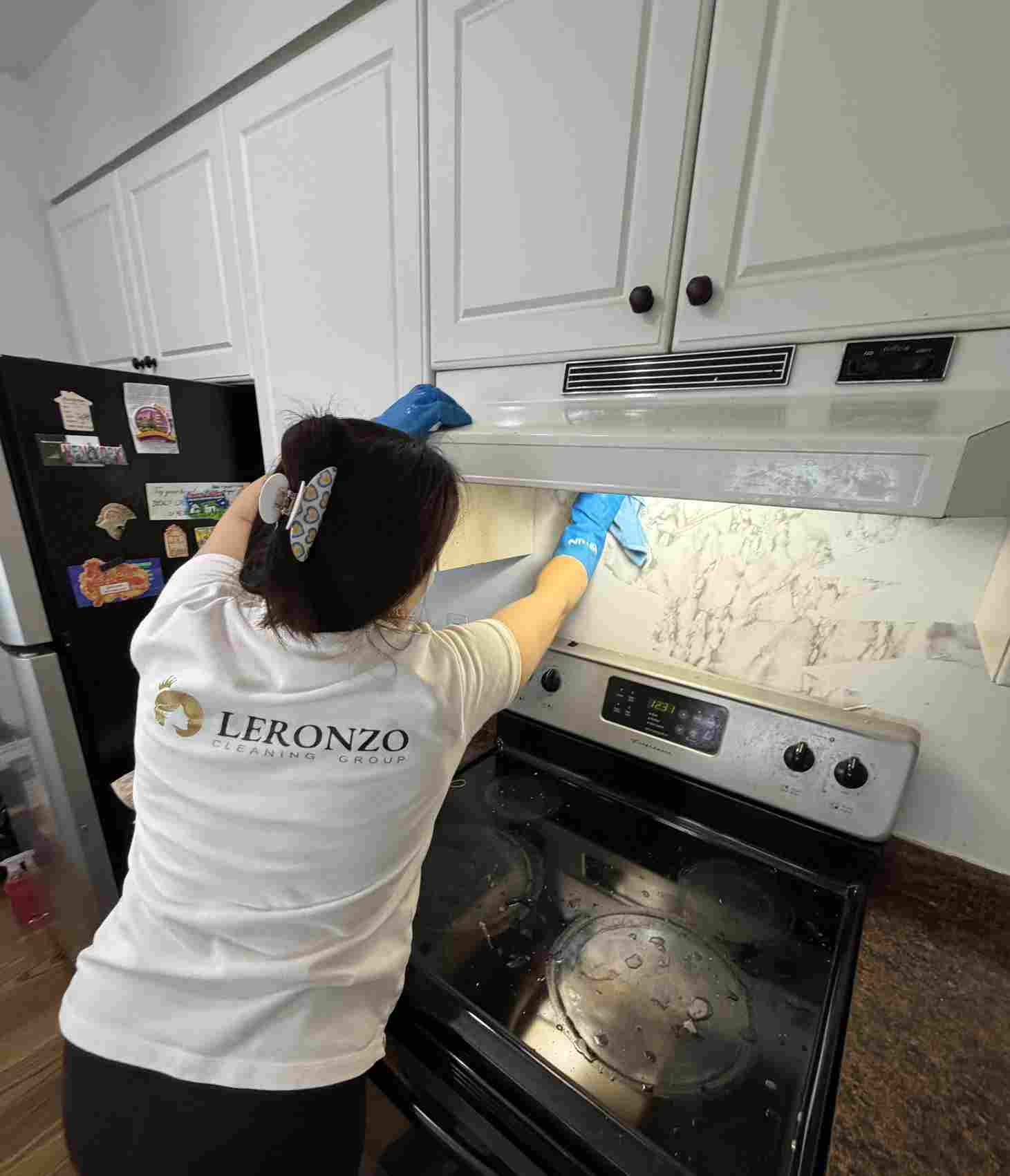
Deep cleaning requires surface-specific decisions, not simply more scrubbing.
Leronzo Cleaning Group’s View: Deep Cleaning Is a Sequence of Decisions
Leronzo Cleaning Group uses checklists. A checklist is necessary for consistency.
But a professional cleaner does not perform a deep clean by mechanically following a list of movements.
A checklist may say: clean the shower.
That one line can describe completely different jobs.
One shower may have light soap residue. Another may have hard-water mineral buildup. Another may have delicate stone. Another may have damaged grout, worn sealant or a finish that reacts badly to an aggressive product.
The task name is the same. The safe method is not.
From Leronzo Cleaning Group’s practical point of view, deep cleaning follows a loop:
Inspect → Identify → Decide → Clean → Check → Adjust
That “adjust” step is important.
A cleaner feels resistance through the cloth, pad, brush or scraper. The cleaner changes pressure and angle. The cleaner sees whether the residue is softening. The cleaner notices whether the finish is becoming dull. The cleaner can immediately reduce force, switch chemistry or stop.
This kind of tactile feedback is one of the reasons today’s humanoid robots are not yet equivalent to a trained professional performing deep cleaning.
Robots can have force sensors and increasingly sophisticated vision. That does not mean they cannot eventually become good at this work. It means the real challenge is more difficult than simply teaching a robot the correct sequence of motions.
Routine cleaning is largely a sequence of tasks.
Deep cleaning is a sequence of decisions.
Would You Trust a Robot — or a Trained Cleaner?
If you would rather have a person assess the surfaces, adjust pressure and technique, and handle the areas that do not fit a standard routine, check the cost of a professional cleaning for your Toronto & GTA home.
Speed: Hourly Price Is Not Productivity
In the viral San Francisco example, the customer herself said a human cleaner would have completed the work faster.
That matches a broader problem in humanoid robotics: impressive motion does not automatically translate into efficient real-world work.
Reuters reported in August 2026 that humanoid robots are progressing quickly but still struggle with intelligence, precision, dexterity and adaptation in practical environments. Recent robot competitions have shown the same contrast: machines can now run at extraordinary speeds, while apparently simple manipulation tasks can still expose major limitations.
House cleaning rewards versatility more than spectacle.
A cleaner can move from a bathroom to a kitchen, notice an unexpected stain, change tools, reach behind an object, clean an edge, change pressure and reorder the remaining work without stopping the entire process.
A robot that performs each movement more slowly can become much more expensive in practice even if the advertised hourly price looks competitive.
This is why a useful comparison should be:
COST PER USEFUL CLEANING RESULT
not simply:
COST PER CLOCK HOUR
What Humanoid Robots Can Already Do — and Where Humans Still Lead
Humanoid robot today:
• vacuum accessible areas;
• basic wiping;
• make beds;
• carry light objects;
• collect trash;
• repeat structured tasks;
• perform some basic bathroom or kitchen maintenance;
• potentially work without fatigue on repetitive motions.
Human professional cleaner:
• all routine tasks above;
• detailed edges, corners and gaps;
• work around clutter and irregular layouts;
• identify different types of buildup;
• change pressure by feel;
• select or change chemistry;
• distinguish dirt from surface damage;
• work with fragile finishes;
• deep-clean kitchens and bathrooms;
• use specialized carpet and upholstery equipment;
• react to unexpected problems immediately;
• inspect quality continuously.
The gap is not permanent. But in 2026 it is still significant.
What Robots May Do Better Soon
It would be a mistake to assume humanoid cleaners will remain at today’s level.
AI is improving quickly. Hardware costs are falling. Vision systems are better. Force sensing is improving. Training data is expanding. Robots are learning from teleoperation and demonstration instead of relying only on manually programmed movement.
Goldman Sachs has pointed to progress in end-to-end AI as one reason humanoid-development timelines have accelerated.
That suggests a realistic progression:
Stage 1 — single-purpose floor robots
Stage 2 — humanoids handling repeatable household tasks
Stage 3 — increasing autonomy in known environments
Stage 4 — better manipulation, judgment and exception handling
Stage 5 — broader competition with human routine-cleaning work
Deep cleaning is likely to be farther along that path because it requires more than navigation and repetition.
Could Toronto Homes Actually Use Humanoid Cleaners?
Toronto & GTA may eventually be a strong market for this technology.
The region has dense condo living, high labour costs, a large residential-service economy and many households already comfortable with on-demand services and home automation.
But successful deployment would require more than a robot that can physically clean.
A real Toronto service would also need to solve:
• travel between homes;
• elevator and condo access;
• insurance and property-damage responsibility;
• privacy for cameras and remote operators;
• safe handling around children and pets;
• winter entry conditions and wet floors;
• carrying supplies and changing tools;
• charging and downtime;
• customer trust;
• liability when the robot damages a finish or breaks an item.
This is why the first successful model may not be “buy a humanoid and replace your cleaner.”
It may be a hybrid model where robots handle repetitive maintenance while trained cleaners handle detail work, inspection, specialty treatments and exceptions.
Where Professional Cleaning Still Has an Advantage
Professional deep cleaning remains difficult to automate because different surfaces need different treatment.
For example, Leronzo’s Deep Cleaning service focuses on accumulated grease, soap and mineral buildup, edges, baseboards, detailed surfaces and overlooked areas. Those are precisely the situations where surface condition and judgment matter.
Specialty services raise the bar further.
Professional Carpet Cleaning may require identifying fibre condition, stains, pet contamination, odours and the correct extraction process. Upholstery Cleaning adds fabric identification and material-specific risk. Those tasks are not simply “more cleaning.” They are different technical processes using specialized equipment.
That does not make automation impossible.
It explains why replacing a robot vacuum is easy compared with replacing the full skill set of a professional cleaner.
Will Robots Replace House Cleaners in Toronto? Our 2026 Answer
For routine cleaning, robots are getting close enough that the question should be taken seriously.
A US$30-per-hour humanoid pilot — about C$42 — is already operating in real homes. Professional cleaning robots are growing rapidly. Investment in humanoids is accelerating. The technology will continue to improve.
But the current evidence does not show a humanoid that can fully replace an experienced professional cleaner across a normal Toronto home.
For predictable maintenance tasks, the gap is narrowing.
For deep cleaning, detailed work, stain treatment, specialty surfaces, carpet extraction, upholstery and unexpected conditions, the gap is still large.
Leronzo Cleaning Group’s view is that automation is more likely to change the cleaner’s job before it eliminates it. Repetitive work can increasingly move to machines. Human value can shift toward inspection, judgment, detail work, specialty treatment, quality control and solving the situations that do not fit a standard script.
The most useful question is therefore not:
“Will robots replace cleaners?”
It is:
“Which parts of cleaning will robots replace first — and which parts still require human judgment?”
In 2026, routine maintenance is the obvious starting point. Deep cleaning is not.
Prefer a Human Cleaner? Get Your Exact Price in 60 Seconds
Humanoid cleaning is developing quickly, but if you want a trained cleaner handling the details today, you can build your cleaning scope online. Choose General or Deep Cleaning, select the rooms and extras you need, and see the price before booking — no phone call or sign-up required.
Related Leronzo Cleaning Services
For routine home upkeep:
Weekly, Bi-Weekly & Every 4 Weeks Cleaning
For detailed accumulated buildup:
Deep Cleaning in Toronto & GTA
For general house cleaning:
House Cleaning in Toronto & GTA
For specialist extraction:
Carpet Cleaning in Toronto & GTA
For fabric and furniture care:
Upholstery Cleaning in Toronto & GTA
Frequently Asked Questions
Can a humanoid robot clean a house today?
Yes, humanoid robots can already perform selected household tasks such as vacuuming, wiping, bed-making and carrying objects. Some services are being tested in real homes. However, current systems may rely on teleoperation and are not yet equivalent to a fully autonomous professional cleaner.
How much does a humanoid robot cleaner cost?
Tau Robotics’ 2026 San Francisco pilot was reported at US$30 per hour, approximately C$42 at the exchange rate used for this article. This was a pilot price, not a Toronto market rate.
Is a robot cleaner cheaper than a cleaner in Toronto?
Not necessarily. Leronzo currently lists hourly maintenance cleaning at C$39 per cleaner per hour. A similar clock-hour price does not mean the same productivity or service scope. The more useful comparison is how much appropriate cleaning is completed in the paid time.
Can a robot do deep cleaning?
Current humanoid robots can perform some physical cleaning actions, but there is not yet strong evidence that they can consistently match a trained cleaner across professional deep-cleaning tasks that require tactile judgment, surface assessment, chemistry selection, detail work and adaptation.
Will AI make robot cleaners better?
Almost certainly. AI is already helping robots learn more general tasks and adapt to new situations. The timing of fully capable autonomous home cleaning remains uncertain.
Will humanoid robots come to Toronto?
It is plausible, but there is no established equivalent of the Tau San Francisco pilot operating as a mainstream Toronto residential-cleaning service at the time of writing. Any Toronto deployment would also need to address insurance, privacy, access, transportation and liability.
Sources and Data Notes
1. People — “Woman Shocked at Backlash After Sharing She Hired a Humanoid Robot to Clean Her Apartment for Just $30” (August 2026)
2. CBS News — “Are humanoid robots ready to scrub your kitchen and take out the trash? Not quite.” (August 11, 2026)
3. International Federation of Robotics — World Robotics 2025 / Service Robots
4. Goldman Sachs Research — “The global market for humanoid robots could reach $38 billion by 2035”
5. Reuters — “China can build kung fu-fighting robots. But it can’t get them to do factory work.” (August 27, 2026)
6. Reuters — World Humanoid Robot Games coverage (August 2026)
7. Leronzo Cleaning Group — Weekly, Bi-Weekly & Every 4 Weeks Cleaning